LoadTester

LoadTester is a modern HTTP and API load testing tool that lets engineering teams run distributed performance checks from browser or CI/CD without.

Visit

Published on:

April 28, 2026

Category:

Pricing:

LoadTester application interface and features

About LoadTester

LoadTester is a modern, cloud-native HTTP and API load testing tool built by Cloud Native d.o.o. for engineering teams that require repeatable, reliable performance checks without the overhead of managing infrastructure. It enables developers and QA engineers to design, execute, and analyze load tests directly from a browser or through CI/CD pipeline integration, eliminating the need to provision servers, orchestrate workers, or handle scheduling complexities. The platform supports both virtual user (VU) mode and requests-per-second (RPS) mode, allowing teams to simulate realistic traffic patterns against their applications. With a cold start time of under three seconds and the ability to scale to 10,000 virtual users or 10,000 requests per second, LoadTester is built for speed and scale. It provides live telemetry during test runs, including throughput, latency distributions (p50, p95, p99), error rates, and active user counts. Post-run, teams can review detailed summaries, compare results across runs, export data in PDF, CSV, or JSON formats, and set automated thresholds for latency and error rates that can trigger auto-stop, Slack alerts, email notifications, or webhooks. LoadTester is designed for teams that want simple, repeatable performance testing integrated into their development workflow, from pre-release gates to scheduled baseline monitoring.

Features of LoadTester

Instant Distributed Execution

LoadTester allows teams to start distributed load tests in seconds without any infrastructure setup, worker orchestration, or scheduling overhead. With a cold start time of under three seconds, the platform automatically dispatches workers and scales them based on the test configuration. This feature removes the painful setup phase typically associated with performance testing, letting engineers focus on analyzing results rather than managing servers. Tests can be launched from the dashboard or triggered via API, with zero queue time for execution.

Live Real-Time Analytics

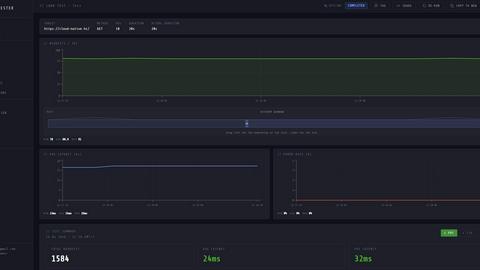
During a test run, LoadTester streams live telemetry data directly to the user interface, including requests per second (RPS), p50, p95, and p99 latency percentiles, error counts, and active virtual users. The latency distribution chart updates every 60 seconds, providing a clear visual of how the system under test behaves under load. This real-time visibility enables teams to spot performance degradation, bottlenecks, or error spikes as they happen, allowing for immediate corrective action or test termination.

Smart Auto-Stop and Thresholds

LoadTester includes intelligent guardrails that allow teams to define failure and latency thresholds before a test begins. If a threshold is breached, the platform can automatically stop the test, preventing wasted resources and unnecessary load on the target system. Users can set conditions such as p95 latency below 400 milliseconds or error rate under two percent. Additionally, regression thresholds can compare results against a baseline run and trigger notifications via Slack, email, or webhook if performance degrades by a configurable percentage, such as 15 percent.

CI/CD Integration and Automation

LoadTester is built for seamless integration into modern development pipelines. It supports scheduled tests, API access, and webhook triggers, allowing teams to run performance checks on every deploy, pull request, or nightly build. Results can be posted to release bots, Slack channels, or email distribution lists automatically. This automation ensures that performance regressions are caught before they reach production, making LoadTester an essential component of a continuous delivery workflow.

Use Cases of LoadTester

Pre-Release Performance Gates

Engineering teams can integrate LoadTester into their CI/CD pipeline to run load tests automatically before every production deployment. By setting strict thresholds for latency and error rates, teams can prevent releases that would degrade user experience. For example, a team can configure a test that simulates peak traffic against a checkout endpoint and automatically blocks the release if p95 latency exceeds 400 milliseconds. This use case ensures that performance regressions are caught early and never reach end users.

Baseline Monitoring and Regression Detection

LoadTester enables teams to establish performance baselines for critical endpoints and run scheduled tests daily or weekly to compare results. When a regression is detected, such as a 15 percent increase in p95 latency compared to the baseline, the platform can automatically notify the team via Slack or email. This use case is essential for applications that undergo frequent changes, as it provides ongoing visibility into performance trends and helps identify the root cause of degradation before it impacts users.

Spike and Stress Testing for Event-Driven Traffic

For applications that experience sudden traffic spikes, such as e-commerce platforms during sales events or ticketing systems during high-demand releases, LoadTester allows teams to simulate burst traffic patterns. Engineers can configure tests with high RPS or VU counts for short durations to validate that the system can handle peak loads without failure. The live analytics during the run help identify bottlenecks in real time, while the auto-stop feature prevents prolonged stress on the target system if thresholds are breached.

API Contract and SLA Validation

Teams that provide APIs to external partners or internal services can use LoadTester to validate that their endpoints meet defined service-level agreements (SLAs) for latency and error rates. By running periodic tests against production or staging environments, teams can generate compliance reports in PDF or CSV format. The ability to compare runs over time and set automated thresholds ensures that any SLA violation is immediately flagged, supporting both operational excellence and customer trust.

Frequently Asked Questions

How does LoadTester handle infrastructure and scaling?

LoadTester is a fully managed platform that handles all infrastructure provisioning and scaling automatically. When you start a test, the platform dispatches workers within three seconds and scales them based on your test configuration, whether you choose virtual user mode or requests-per-second mode. There is no need to provision servers, manage load generators, or orchestrate worker nodes. The platform abstracts all infrastructure complexity, allowing you to focus on test design and result analysis.

What types of tests can I run with LoadTester?

LoadTester supports HTTP and API load testing, including GET, POST, PUT, and DELETE methods. You can configure tests in either virtual user (VU) mode, which simulates concurrent users, or requests-per-second (RPS) mode, which targets a specific throughput rate. Tests can be run on demand, scheduled for recurring execution, or triggered via API from CI/CD pipelines. The platform also supports setting thresholds for latency percentiles and error rates, with options for auto-stop and notifications.

Can I compare test results across different runs?

Yes, LoadTester provides run-to-run comparison capabilities. After each test, you can review detailed summaries including total requests, average latency, p95 latency, data sent, and data received. The platform allows you to compare these metrics against previous runs or a defined baseline. If a regression threshold is set, LoadTester automatically flags performance degradation and can notify your team via Slack, email, or webhook. Results can also be exported in PDF, CSV, or JSON formats for external analysis.

How do I integrate LoadTester into my CI/CD pipeline?

LoadTester offers API access and webhook support for seamless CI/CD integration. You can trigger tests programmatically from tools like Jenkins, GitHub Actions, GitLab CI, or CircleCI using the LoadTester API. The platform also supports scheduled tests that run at defined intervals, such as nightly or on every deploy. After a test completes, webhooks can send the result link to your release bot, Slack channel, or email distribution list, enabling automated performance gates in your deployment workflow.

Pricing of LoadTester

LoadTester offers a free plan that allows teams to start running HTTP and API load tests immediately without any upfront cost. The free plan includes access to the core platform features, including live analytics, threshold configuration, and run-to-run comparisons. For teams that need higher concurrency limits, longer test durations, scheduled tests, API access, and priority support, LoadTester provides paid plans with tiered pricing based on usage. Specific pricing details for the paid plans are available on the LoadTester website under the pricing section. Teams can start with the free plan and upgrade as their performance testing needs grow.

Top Alternatives to LoadTester

Game Server Backend - product for Dev Tools

Game Server Backend

Hosted multiplayer game backend with key features.

Headless Domains - product for Dev Tools

Headless Domains

Agents get a persistent, verifiable web identity.

GPT Image 2 API - product for APIs

GPT Image 2 API

GPT Image 2 API lets you generate high-quality AI images online using GPT Image 2. Simple API, fast results, and developer-friendly integration.

Json Translator - product for Dev Tools

Json Translator

The easiest json translator to instantly translate JSON files online while keeping structure, keys, and formatting intact.

MuseSpark AI - product for Dev Tools

MuseSpark AI

MuseSpark AI transforms your creative inspirations into reality with powerful models for text, audio, image, and video content creation.

ul0 - product for Dev Tools

ul0

ul0 is a free URL shortener that instantly creates permanent links, tracks clicks, and generates UPI QR codes without any signup required.


Woz - product for Dev Tools

Woz

Woz is an AI mobile app builder that enables entrepreneurs to effortlessly create high-performance applications with significant cost and time.

Seedance 2.0 Web & API - product for AI Assistants

Seedance 2.0 Web & API

Generate cinematic short-form videos from text or images with Seedance 2.0's fast API and web app, supporting up to 1080p and 15 seconds.