
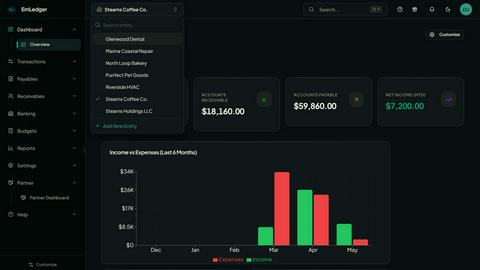
About EmLedger
EmLedger is multi-entity accounting software for businesses that outgrew a single set of books. Manage unlimited LLCs, subsidiaries, franchise locations, rental properties, brands, or client accounts from one login, each with its own real double-entry ledger, chart of accounts, and audit trail.
Switch entities in one click, or consolidate instantly. EmLedger generates consolidated P&L, balance sheet, and cash flow across any group of entities, with inter-company transactions eliminated automatically, no exporting to Excel to stitch books together by hand.
Unlike QuickBooks, Xero, FreshBooks, and Wave which charge per company and force manual consolidation across separate logins, EmLedger bills one flat tier price no matter how many entities you run. Every plan includes all 140+ features, 36+ reports, unlimited users, unlimited transactions, and bank connections.
Solo $49/mo (1-3 entities), Growth $129/mo (4-15), Enterprise for 16+. Free 14-day trial, no card required.
Top Alternatives to EmLedger


Liners Africa
Liners Africa is your comprehensive guide to discover, compare, and review software solutions tailored for the African market.

VolRadar
VolRadar delivers daily options analytics for premium sellers, ranking 500+ S&P stocks by volatility edge with computed strikes for 30-second morning.

PopPay
PopPay is a free, SARS-compliant invoice and accounting software for South African small businesses, integrating seamlessly with WhatsApp and EFT.
StockFit API
StockFit API delivers structured SEC data for precise financial modeling, valuation, and backtesting for investors and researchers.

CalcFi
CalcFi offers 300+ free financial calculators that integrate federal data to provide a comprehensive financial overview tailored to your needs.

Wize Finance Eligibility Check
Wize Finance Eligibility Check lets UK limited companies explore business loan options and funding eligibility without impacting their credit score.

Ember
Ember leverages three independent AI models to identify high-conviction market signals by tracking discrepancies in real-time predictions.